Contributors

Thursday, May 28, 2015

Propagation Program - Orientation Day with Notes on the Wild Plants of Burden

It was a lovely day at Burden to dig into the nitty gritty of the propagation program. There are still many details to be worked out but so far, so good. Those who attended: Kitty Bull, Britton Hailor, Paul Orr, Cyndi Levi, Julie Morgan, Tricia Hunt, Helen Peebles, Dick Erlicher, Joe Delotte, Julia Hawkins, James Henson, Allan Pringle, Dianna Moritz and Matthew Herron (that's me!).

The outline as it was discussed in the meeting is featured on our new Propagation Webpage (click here). We potted roughtly 20 flowering dogwoods, 10 mockernut hickories, 10 redbuds, and 7 black-eyed susans. While we intended to start our own work area on the research side of Burden, the Master Gardeners have been generous enough to allow us to use their work benches and tools, as long as we keep things clean and organized. Next work day will be June 21st from 4-6pm.


In other news, I've been continuing to explore and think about the Burden site and its potential for ecological restoration and native plant diversity. Some interesting specimens have been found out there and we'll have to continue exploring to understand what plant populations can be conserved, enhanced or, in some cases, restored.

This aquatic milkweed (Asclepias perennis) was purchased from Cleggs and planted in a low wet area in the restoration portion of woods at Burden. More of an experiment than anything else, my hopes are that we can get enough genetic diversity in this area to build a happy, reproducing population of native milkweed from which we might collect seeds. Hopefully they will also disperse naturally into the landscape and find its own niche in other parts of Baton Rouge. The closest known wild population is at Bluebonnet Swamp.

Burden also has some nice populations of wildflowers due to some areas that are being managed with low- or no-mow areas. Here you can see a profusion of Clasping Coneflower. We'll hopefully be collecting a few seeds from around the area when they are ready. This species is fairly agressive and easy to grow so would be good for a variety of settings and skill levels for native gardeners. 
Dianna found an interesting legume which we debated over some. After reviewing some of the options in our area, I believe it Bigpod Sesbania (Sesbania herbacea). It loves wet areas and germinates readily on moist bare mineral soil, as can be found on swamp edges as the summer heat dries up shallow waters.
Later that day after on a hike, I found some obedient plant growing in a low-mow zone. A wild plant, for all I can tell. There is a known population at Bluebonnet also. Driving East towards Livingston Parish, they become more abundant on the roadsides, but it is not clear whether that is purely due to changing soils or due to change in management of roadsides. Baton Rouge may just be using more herbicides to manage roadsides than out in the country.

Well that is all folks! Stay tuned for more propagation reports and our next field trip we are planning for June.

Matthew

Thursday, February 12, 2015

Invasive Species Art at the LASM in Baton Rouge

There is a very cool exhibit at the Louisiana Arts and Sciences Museum (LASM) here in downtown Baton Rouge. It is both educational and beautiful, combining both natural sciences and modern art. It seems that Megan Singleton and I are on the same wavelength, as I had come to a similar idea not too long ago: make art and education out of noxious invasives. The exhibit brings attention to the growing threat of invasive plants in our local wetlands. The exhibit is open until March 15 and I highly encourage you to go check it out, if you have the chance. You could also write Ms. Singleton and the LASM to thank them for their wonderful work. These kinds of public environmental education projects need all the support they can get. Megan Singleton has her own website and has done much art in her career. You can visit that and thank her by clicking HERE.

From the LASM website:

"Manchac: In the Wake of North Pass explores the destructive beauty and complex role of invasive aquatic plants upon the fragile ecology of Louisiana's bayous. Singleton researched the state's waterways and traveled by canoe to collect the Water Hyacinth and Alligator Weed that she transformed, first into paper and then into evocative pulp paintings and sculptural works. A video comprised of over 500 still photographs of water and a large-format handmade book provide further insight into the artist's process. A native of St. Louis, Singleton received her MFA in sculpture from LSU in 2012."


Background info on the exhibit.

A surreal three-dimensional piece representing aquatic plants that makes you feel like you are swimming in water. The material is a kind of paper machet made from water hyacinth (Eichornia crassipes) and alligator weed (Alternanthera philoxeroides)
A tumbleweed-like dried plant, mounted to brass, like a hunter's trophy. Lauren and I waxed-botanic about this one for a moment. I think that is is a sea rocket (Cakile sp.).
Lauren checking out a book of photographs depicting the terrible beauty of a land suffering from invasion. Printed on handmade paper.
One of my favorite pages in the book. Notice Chinese Tallow (Triadica sebifera) to the right...

A little booklet on invasive species with quotes from our very own Kelby Ouchley of Bayou Diversity.
Lauren Hull and I (past presidents and partners in crime) went together to check it out and by the end or our trip were feeling very inspired. I think we will be writing Ms. Singleton very soon to thank her for her work and to see if she has in future plans working with invasive species as art.

Perhaps she'd be interested in the idea that I had some time ago to make art from Chinese Tallow. If you are not already aware, Chinese Tallow is an invasive tree that is decimating our wetlands in Louisiana, by crowding out native species and altering soil characteristics. Once diverse bottomlands with upwards of 50 different species of hardwoods or slowly becoming single species stands of tallow, especially in the wake of human disturbance and clearcutting. It has a more visible and dramatic impact on our endangered coastal prairies. In these areas in Southwest Louisiana and Southeast Texas, grasslands are turning into single-species forest, altering fuel loads and making prescribed fires difficult, removing habitat for threatened and endangered plants and animals such as the Attwater Prairie Chicken and confusing spring migratory birds, who come to rest in these trees after crossing the gulf to find forests with few invertebrates to feed on. To read more on the damage follow this link to the US Fish and Wildlife Services. Chinese Tallow also happens to be a plant with over 1000 years of ethnobotanical history in China and has been used to make candles, dyes, print blocks, furniture, wooding carvings and more.


The idea I had was to pair conservationists with a diverse group of artists, some from LSU and some from the community at large, to visit some invaded sites and see the damage. Give them the opportunity (if they choose and are interested) to help remove invasive and replant natives, but mostly provide them with free materials to make the art and to showcase it in a public art exhibit located in a prominent gallery with high traffic. With a nice opening reception, I think this could be a real success in terms of both bringing diverse audiences into conversation and having a grand ole' time.

What do you think? As an artist myself who has been working in conservation for several years now, I long for the opportunity to get my hands dirty again with paint... and soil too!

For more information on Megan Singleton's exhibit visit:  http://www.lasm.org/exhibitions-collection/art-exhibitions/

Saturday, January 31, 2015

Finding Real Baton Rouge in Anywhere, USA

I grew up in the suburbs of southeast Baton Rouge. I didn't live in neighborhoods; I lived in subdivisions. They had forest-themed names: Avalon, Wedgewood, and Woodland Ridge. Originally, I suppose, they were each near some land that was rather wooded. Small pockets of original forest and clay creeks where I played and whose days were numbered before they, too, became ranch houses, parking lots, or school baseball fields bordered with the usual Asian plant stock. Over time, Baton Rouge to me meant less natural forest and more manicured lawns, more roads, more cars, more chains. More characterless, soulless sameness. By 12th grade and throughout college, Baton Rouge to me was Anywhere, USA.

Anywhere, USA

After graduating from LSU, I received a letter from the Office of then-Governor Foster that basically said "please don't leave Louisiana":
As you know, Louisiana is a great place to live and play, and my goal is to make sure we're equipped to be a great place to do business as well.... I'm asking you to put your talents to work right here and practice your chosen profession in Louisiana.
Around this time, I was phone-interviewed (by the Greater Baton Rouge Business Report) on the matter and was quoted as saying "At this point I hope to stay in the state, but it's amazing how little there is in the state." This was surely a paraphrase as I tend not repeat prepositional phrases like this, but it has the gist. I didn't see anything of value in Baton Rouge other than it's where I grew up. Nature was definitely not in my thoughts, and how could it have been given the state of the suburbs?

A few years ago and many years after my misheard words were scribbled down, I had a career break and began weighing the real possibility of moving somewhere else in the country. At the same time, I had plenty of time available to me to see what all is out there in the humid, soulless city of Baton Rouge, a luxury I didn't have when I was siloed up at my previous computer-centric job. I found CPEX and the Smart Growth Summit, the Downtown Development District, Bike Baton Rouge, Foundation for Historical Louisiana, FuturEBR, the growing Government Street movement, and the newly formed Capital Area Native Plant Society. I was beginning to feel like things could actually get better here.

I had just bought a house pre-career break — great timing — and I was starting to enjoy the freedom of having my own garden canvas. If I wanted, I could leave areas unmowed to see what came up. There were plants there that nobody ever let grow, and they were FREE. Being without an income, I definitely had an incentive to see what they were. I was getting sick of the usual azaleas and crepe myrtles. As I researched these new "wild" plants and others I was buying at nurseries, I realized how many of the species I grew up with in the suburbs aren't even from here. This didn't jive with my emerging sense of place and my wanting to realize that I'm not separate from the world outside my window.

As I was learning plant names and could identify them, I made a list of what I'd seen growing around my new neighborhood. (No longer do I live in a subdivision, thankfully.)
  • lots and lots of turfgrass
  • azalea
  • crepe myrtle
  • monkey grass
  • philodendron
  • camellia
  • gardenia
  • Bradford pear
  • lantana
  • sago palm
  • knockout rose
  • chrysanthemum
  • camphor
  • tallow
  • Chinese rain tree
  • ligustrum
  • nandina
  • cast iron plant
  • oleander
  • boxwood
Only a couple are even from the Americas (lantana and philodendron), and none are native to East Baton Rouge Parish. (St. Augustine turfgrass is oddly native-esque, but it looks like mostly to coastal areas.) They vary from sterile to invasive to outright toxic. And these are in nurseries and garden centers around the country, being bought and planted in every city. Anywhere, USA, indeed. (True, my neighborhood does have a ton of live oaks and Southern magnolias. I can even see an American sycamore on the next block. But these are definitely a minority of the species.)

As time went on, I realized a lot of those wild plants that were volunteering themselves were also exotic invasives. Chamberbitter is perhaps the worst in my yard. However, when I knew what I was looking for, I also find some natives:
  • asters
  • Virginia creeper
  • pepper vine
  • wild grape
  • straggler daisy
  • spiderwort
  • daisy fleabane
  • dogfennel
  • lateflowering throroughwort
  • goldenrod
  • viola
  • yaupon
But most natives won't just magically appear out of a bird's butt or or float in on a cool breeze, so I have to actively acquire and sow or plant them. And that's where I am now, working to restore my little parcel of suburbia to have Real Baton Rouge growing once again.

Tuesday, January 20, 2015

Arbor Day and Restoration at Burden

On January 10, I had the pleasure of joining fellow CANPS members Brian Early and Allan Pringle and their co-worker Michael at the Burden Botanical Gardens. The weather was nice: cool, clear. I showed up a few minutes early to check out the trails and was surprised at what I saw. I had been several years prior for a Project Learning Tree workshop and remembered there being something of a forest there, though the canopy was heavily disturbed. What stood there now was a bit of an open, park-like environment. There were trees but the forest floor was relatively flat and covered with rye grass and weeds. My first reaction was, I have to admit, disappointment. I could have sworn that they were mowing in there. I thought to myself, 'Oh god, yet another forested area has succumb to the ceaseless mowing and tinkering of man'.

I was fortunate enough to later talk with Jeff Kuehny, who has been leading this project for several years now. He explained to me that they had a terrible privet infestation following Gustav and they had been getting rid of that and mulching the ground over to keep it from resprouting. An incredible undertaking. It is definitely the most ambitious ecological restoration project in Baton Rouge that I have seen yet. Each year, they take advantage of Arbor Day enthusiasm to stick as many trees in the ground as possible. Native trees, of course. This year some 400 trees were slated to be planted. On the list were Green Ash (Fraxinus pennsylvanicus), Red Maple (Acer rubrum), Bald Cypress (Taxodium disctichum), Eastern Cottonwood (Populus deltoides), Pecan (Carya illinoiensis), White Oak (Quercus alba), Swamp Chestnut Oak (Quercus michuaxii), Swamp Tupelo (Nyssa aquatica) and Black Gum (Nyssa sylvatica). 

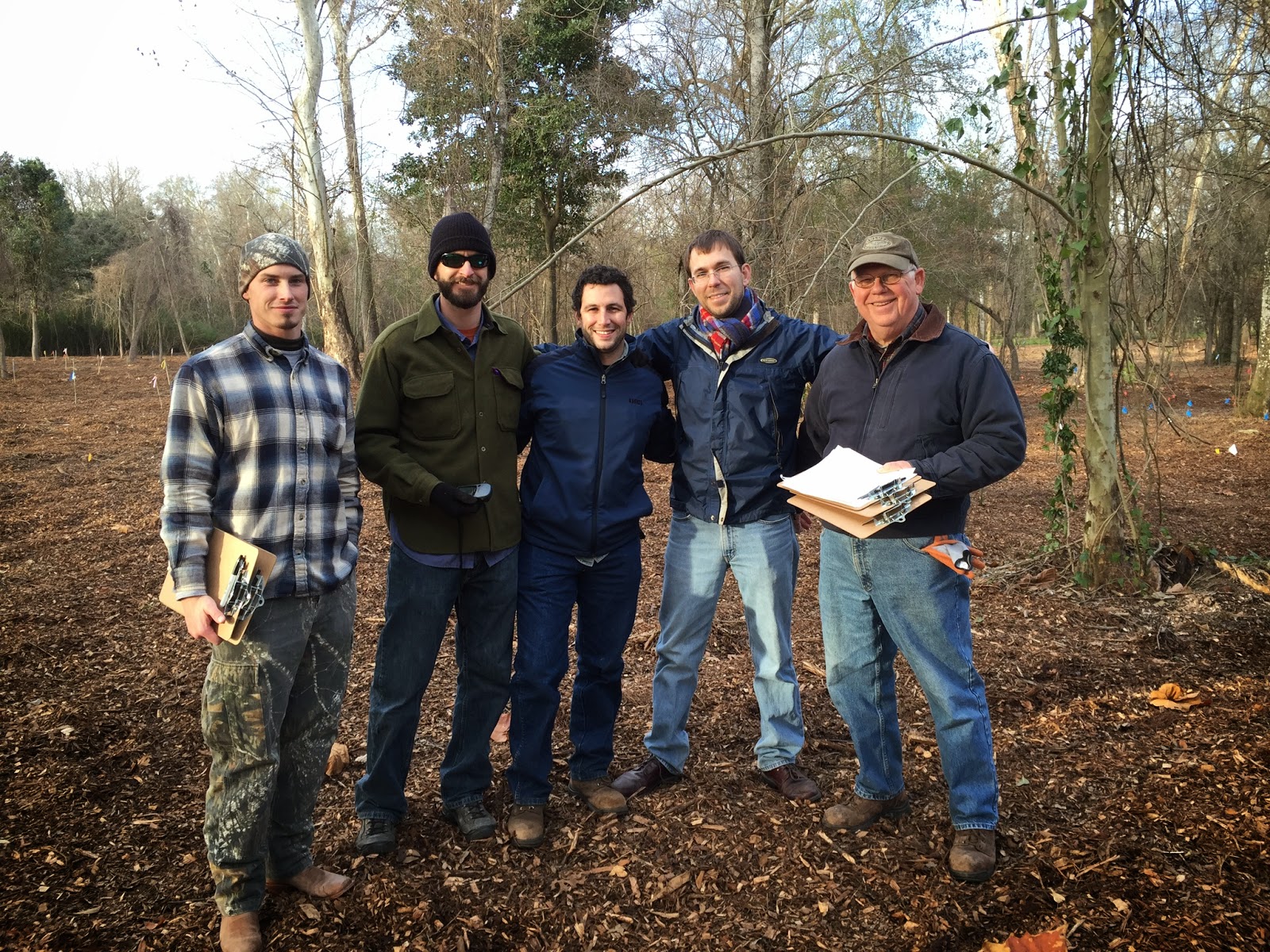
Our goal for the day was to take GPS coordinates at each stake so that visitors who plant trees can come back to their trees years later to watch it grow. Brian and I spent a few hours talking CANPS 2015, botany and restoration while we worked. I jotted down GPS locations to each planting location while Brian wrote numbers on the flagging on each stake where a tree would later be planted. 


Next week visitors would pick their tree, match the tree to the color-coded flagging somewhere out in the field, plant the tree and then tear off one of the numbers so that they could retrieve info on their tree, such as the species, growth habits and coordinates.

When arbor day came, I showed up early, enjoyed the free coffee and bumped into several folks that I had seen at previous CANPS meetings. You couldn't have asked for more perfect weather. Crisp and gently warming. Clear skies. I filled out my name tag and made sure to write Capital Area Native Plant Society. It caught a few folks attention and by the end of the day I was able to add several names to our mailing list. Master Gardeners and Burden Horticultural Society members, Ready Hands and others. Kindred spirit, for sure. We all delight in the idea of nurturing life, of cultivation and getting our hands dirty.


People came in waves all day, mostly young families with lots of children, but occasionally older couples and loners too. The kids brought so much excitement and energy to the experience. Like planting a tree was the coolest thing that anyone could be doing. I remember one boy couldn't contain himself and so, without waiting for instruction or considering which tree he wanted, ran up, grabbed a random tree and began running toward the open distance. I looked over to his mom, who was laughing with me. We grabbed a shovel and started chasing after.


I loved every second of it. The weather. The volunteers. The visitors. Getting my hands in native soil and doing good work. The children especially made my day. I couldn't think of a better way to spend a weekend. Could you?

By Matthew Herron

Wednesday, January 14, 2015

Welcome to ludoviciana!

Welcome to ludoviciana, the Capital Area Native Plant Society's new blog!! 

The word "ludoviciana" is the latinized version of Louisiana and several native plants found in Louisiana have been described with this epithet, such as Louisiana vetch Vicia ludoviciana and Louisiana Nerveray Tetragonotheca ludoviciana (more on botanical nomenclature later). I thought it was a fitting name for a botanical blog operating out of the capital. 

Stay tuned for posts on local conservation and restoration efforts, plant ID and propagation tips and much much more! The blog itself will be getting a makeover soon. The first content post is already in the works but not quite ready... so until then, thanks for visiting!

Matthew Herron